You’re looking at a chipped, discolored, or worn-down tooth that’s bothering you. You’ve done enough research to know that two options keep coming up: dental crowns and porcelain veneers in Arlington Heights. Now you’re trying to figure out which one you actually need.
It depends on what’s happening underneath the surface. A veneer and a crown can look nearly identical once they’re in place, but they do work different jobs. One enhances a healthy tooth, and the other rebuilds a compromised one.
At Arlington Advanced Dentistry in Arlington Heights, Dr. Ryan Springer evaluates that distinction every day. He’s one of only about 400 dentists worldwide accredited by the American Academy of Cosmetic Dentistry, and he and Dr. Stevan Orser were the only two partners in Illinois with that accreditation. That training matters here, because choosing between a veneer and a crown isn’t just a cosmetic decision. Here’s how to think about it so you can make the best choice.
The Short Version: Enhance vs. Rebuild
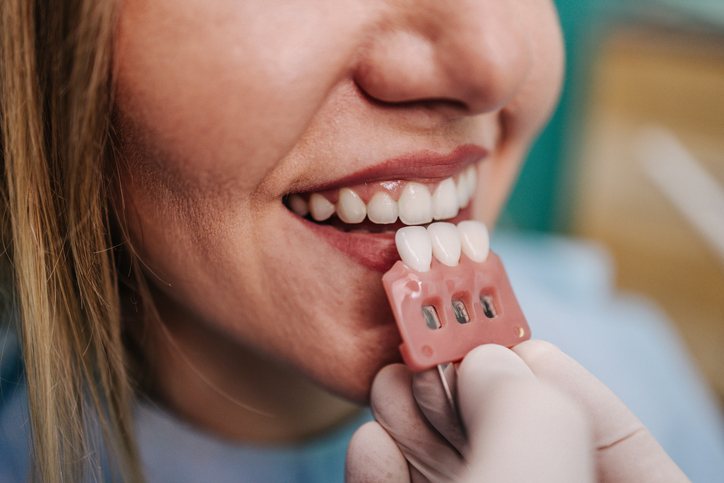
A porcelain veneer is a thin shell of porcelain bonded to the front of a tooth. It’s a cosmetic treatment, and it’s conservative by design. Most of the natural tooth stays intact underneath.
A crown is a cap that covers the entire tooth above the gumline. It rebuilds strength and protects a tooth that’s cracked, heavily filled, or weakened. It’s a restorative treatment first and a cosmetic one second.
The simplest way to decide is to ask one question. Does this tooth need to look better, or does it need to be stronger?
If the answer is “look better,” a veneer is usually the right call. If the answer is “stronger,” a crown is usually necessary. Sometimes the answer is both, which is why the evaluation matters more than the label.
When a Veneer Is the Right Choice
Veneers are for teeth that are structurally healthy but cosmetically imperfect. Dr. Springer uses them to address concerns like stains that don’t respond to whitening, small chips or cracks, minor gaps between teeth, and teeth that look slightly short or uneven.
The key word is “healthy.” If the tooth underneath the veneer is sound, a veneer can transform its appearance while preserving almost all the natural structure. The preparation is minimal, removing less than a millimeter of enamel from the front surface. That conservatism matters for the long term, because the more natural tooth you keep, the more options you have if the restoration ever needs replacement.
For patients in Arlington Heights, Mount Prospect, or Palatine who are unhappy with the appearance of their front teeth but have no pain, cracks, or large fillings, veneers are the straightforward answer.
When a Crown Is the Right Choice
Crowns are necessary when the tooth needs structural support, not just a better appearance. The situations where Dr. Springer recommends a crown include:
- A tooth that’s cracked or fractured
- A tooth with a large filling that’s failing or that occupies more than half the tooth’s structure
- A tooth that’s had a root canal and needs protection from fracture
- A tooth that’s worn down significantly from grinding
In those cases, a veneer would be a mistake. It would cover the front of the tooth but leave the compromised structure underneath unsupported. The tooth could keep failing, and the veneer would fail with it.
A crown encases the entire tooth, holding it together and distributing chewing forces across the whole surface. It’s the more protective option, and for a tooth that’s already weakened, protection comes first.
The Same-Day Difference at Our Office
This is where the conversation gets more interesting for patients in Arlington Heights. Most practices that offer crowns require two visits. The tooth is prepared, an impression is taken, a temporary crown is placed, and you come back two or three weeks later for the permanent crown. That’s the traditional model, and it works.
At Arlington Advanced Dentistry, we use CEREC technology to design, mill, and place same-day crowns in a single visit. We prepare the tooth, scan it digitally, and fabricate the restoration in our office while you wait. You leave with a permanent crown, not a temporary one. No second appointment, no temporary that can come loose, no waiting.
That matters for patients who are anxious about dental work, have busy schedules, or simply don’t want to make two trips for one tooth. Dr. Springer’s training at the Dawson Academy, Kois Center, Pankey Institute, and Spear Institute includes advanced training in complex reconstructive dentistry. The same-day workflow reflects how that training is applied in a practical setting.
Veneers follow a different process. Veneers are custom-crafted in a lab, and the process typically involves a planning visit, a preparation visit, and a bonding visit. The trade-off is that veneers can be designed with a level of cosmetic customization that’s harder to achieve with a same-day crown. For front teeth where the appearance is the priority, that customization matters.
The Middle Ground: When It’s Not Obvious
Sometimes the decision isn’t clear-cut. A tooth might be mostly healthy but have one large filling, or it might be slightly worn but not severely damaged. It might have a cosmetic concern that either option could address.
These are the cases where Dr. Springer’s AACD accreditation matters. The accreditation process requires demonstrating expertise in cosmetic diagnosis and treatment planning, not just technique. That means the evaluation isn’t just “can this tooth hold a crown?” It’s “what will this tooth look like, and how will it function, five and ten years from now?”
In some cases, the answer is a crown on one tooth and a veneer on the next, planned together so they match in shade and shape. In other cases, the answer is neither. Bonding, whitening, or orthodontics might achieve the goal with even less intervention. The right recommendation depends on seeing the tooth, understanding the bite, and talking through what the patient actually wants.
What the Evaluation Actually Involves
When you visit Arlington Advanced Dentistry with a tooth that’s bothering you, here’s what the visit looks like.
Dr. Springer examines the tooth, the surrounding teeth, and the bite. He takes digital imaging to see what’s happening underneath the surface, including the health of the tooth structure and any existing restorations. He talks with you about what you’ve noticed, what bothers you, and what you’re hoping the result will be.
From there, he’ll explain whether the tooth needs structural support or cosmetic enhancement, and why. If a crown is the right choice, he’ll explain the same-day option and whether your tooth qualifies. If a veneer is the right choice, he’ll explain the process and the customization involved. If neither is right, he’ll tell you that too.
Our practice is at 1845 E Rand Rd, Suite 200, in Arlington Heights. Patients come from Rolling Meadows, Prospect Heights, Mount Prospect, Palatine, Wheeling, and throughout the northwest suburbs. We focus on adult care, so recommendations are built around adult concerns like wear, previous restorations, and long-term function.
The Questions to Ask Yourself
Before your visit, consider these questions:
- Does the tooth hurt? Pain or sensitivity often signals a structural issue that a veneer won’t fix. A crown is more likely to be the answer.
- Has the tooth had a root canal or a large filling? Those are signs the tooth is already compromised and needs protection.
- Is the concern purely cosmetic? If the tooth is healthy and the issue is appearance, a veneer is the more conservative path.
- Do you want to minimize visits? A same-day crown can be completed in one appointment. Veneers take multiple visits.
- How important is customization? For front teeth where the appearance is the priority, veneers offer a level of design flexibility that’s harder to match with a same-day crown.
What to Do Next
If a tooth is bothering you and you’re not sure whether it needs a veneer, a crown, or something else, start with an evaluation. Not a sales pitch. A real look at what’s happening with the tooth and your options.
Call Arlington Advanced Dentistry at 224-491-4229 or request an appointment online. We’ll take a look, explain what we see, and give you a clear recommendation based on the tooth, not on what’s easiest to schedule.
You don’t have to guess which restoration is right. You just have to find out what the tooth actually needs.